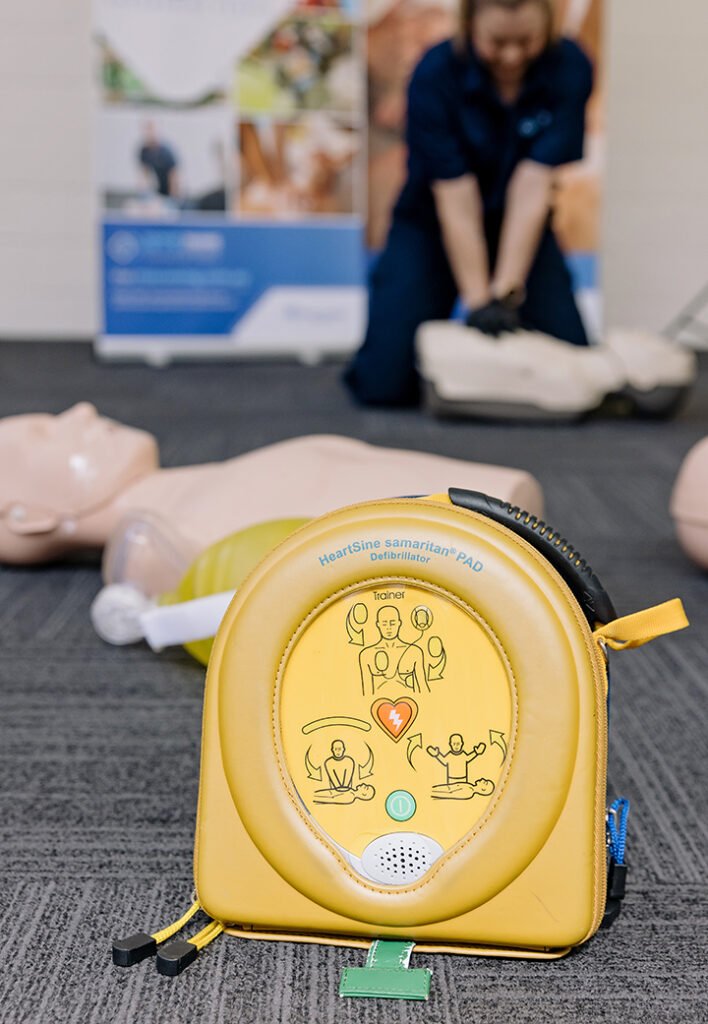
DRSABCD stands for Danger, Response, Send for help, Airway, Breathing, CPR, and Defibrillation. It’s the first aid action plan taught in every nationally accredited course in Australia, and it’s the framework your team will rely on if someone collapses, stops breathing, or has a cardiac arrest in your workplace.
Most people who’ve done a first aid course can recite the letters without thinking. Fewer can work through them calmly with a real person on the ground in front of them. That’s the gap training is designed to close, and it’s what we see play out in our training rooms in Perth every single week.
Here’s what each step actually involves, and what people tend to get wrong.
D — Danger
Check whether the scene is safe before you approach. In a Perth office that might mean a wet floor or an electrical hazard. On a construction site, it could be live equipment, chemical spills, or falling objects. Our trainers see the same mistake every time in scenario practice: people spot the casualty and stop scanning the environment around them.
R — Response
Talk to the person loudly -“Can you hear me? Open your eyes” and squeeze their shoulders firmly. You’re checking for any sign of consciousness. If they respond, talk to them and assess what’s happened. If they don’t respond to voice or touch, they’re unconscious and you need to move quickly. The common mistake here is being too gentle. A light tap and a quiet “are you okay?” isn’t enough to determine whether someone is genuinely unconscious.
S — Send for Help
Call Triple Zero (000) immediately. In WA, your call goes to St John Ambulance, which targets 90 per cent of priority one responses within 15 minutes in the Perth metro area. Point at a specific person and say “You, call 000 now” – if you shout it to a group, everyone assumes someone else is handling it. If your workplace has an AED, send someone to grab it at the same time. St John WA’s First Responder app can help locate the nearest publicly accessible defibrillator, and over 200,000 Western Australians have already downloaded it.
A — Airway
When someone is unconscious, their tongue can fall back and block the airway. Tilt the head back gently with one hand on the forehead and lift the chin with two fingers of the other hand. This opens the airway and is one of the simplest lifesaving actions in first aid. In our practical sessions, people almost always don’t tilt far enough – the correct angle is something that clicks much faster with hands-on practice than from reading about it.
B — Breathing
With the airway open, look at the chest, listen, and feel for normal breathing for up to 10 seconds. Normal breathing means regular, effortless breaths. Occasional gasps or gurgling (sometimes called agonal breathing) is not normal and is a sign of cardiac arrest. This is one of the most important distinctions in first aid, and mistaking agonal breathing for real breathing is one of the most common errors we see in training.
C — CPR
If the person isn’t breathing normally, start chest compressions immediately. Push hard and fast on the centre of the chest at least 5 centimetres deep, at a rate of 100 to 120 compressions per minute. Give 30 compressions, then 2 rescue breaths, and repeat. If you can’t or won’t give breaths, compressions alone are still far better than nothing. Almost everyone pushes too softly at first which is why we use training manikins that give real time depth feedback, and students are always surprised by how much force is actually needed!
D — Defibrillation
Turn on the AED and follow the voice prompts, the machine tells you exactly what to do. A common misconception is that defibrillators restart stopped hearts – they actually correct abnormal heart rhythms so the heart can resume beating normally. They won’t shock someone who doesn’t need it, so the biggest risk isn’t using one incorrectly it’s not using one at all because nobody was confident enough to grab it.
Knowing it and doing it are two different things
You can read DRSABCD a hundred times and still hesitate when it matters. The reason first aid courses include scenario practice is so that the steps start to become automatic, and the gap between knowing what to do and actually doing it gets smaller every time you rehearse it.
That’s the shift we see in every course we run at RTS Training. Students walk in knowing the acronym and walk out feeling more confident in what it feels like to use it.
RTS Training delivers Provide First Aid (HLTAID011) and CPR (HLTAID009) courses daily at our Osborne Park training centre in Perth, with onsite delivery available anywhere in WA. All courses delivered on behalf of Allens Training Pty Ltd (RTO 90909).
Book your first aid course or call (08) 9443 1000.
FAQ
What does DRSABCD stand for? DRSABCD stands for Danger, Response, Send for help, Airway, Breathing, CPR, and Defibrillation. It is the first aid action plan used in all nationally accredited first aid courses in Australia.
What is the difference between DRSABCD and DRABC? DRABC was the older version. DRSABCD was updated to include Send for help (prompting earlier 000 calls) and Defibrillation (reflecting the growing availability of public AEDs and the evidence that early defibrillation improves cardiac arrest survival rates).
How often should I renew my first aid training? Provide First Aid (HLTAID011) is valid for three years, but the CPR component (HLTAID009) must be renewed every 12 months.
Where can I find an AED in Perth? St John Ambulance WA maintains a defibrillator register through their free First Responder app, which shows the nearest publicly accessible AED to your location.